Monday, October 23, 2006

Patent Information News 3/2006

The October 2006 issue of Patent Information News is now available.

This issue contains articles on:

  • Worldwide database moves to XML
  • EPO patent information conference, Nov. 6-8
  • esp@cenet user statistics
  • Open Patent Services: new features
  • Legal status from New Zealand
  • Data from Iceland
  • Patent mapping--a aid to corporate decision-making?

Monday, October 16, 2006

WIPO Student Workbook to Inventions and Patents - Now in French and Spanish

The educational workbook Inventions and Patents is now available in English, Spanish and French. The workbook is geared toward students 8-13 years old. The workbook is the first in the WIPO student learning series, Learn from the Past, Create the Future.

WIPO Report on Worldwide Patent Activity


The World Intellectual Property Organisation has published its annual report on Statistics of Worldwide Patent Activity. (Data current to 2004.)

According to the report, the number of patent applications file in 2004 rose to 1,559,000. More than 600,000 patents were granted worldwide in 2004. Other sections of the report cover filings by residents and non-residents, indicators of patent activity (filings per million population, per GDP, etc.), issued patents and patents in force.

Inventor Cuts Against the Grain


Independent inventors often underestimate the hurdles they must overcome in order to get their invention to market. Most don't even consider the government regulations and industry standards that could derail their attempts.

Take the case of Stephen Gass reported in the Oct. 10 Washington Post. Mr. Gass invented a device that he claims prevents power saws from inflicting severe injuries by stopping a rotating blade in fractions of a second. Sounds like a no brainer, right? But the power tool industry balked at licensing his invention. It even failed to win the endorsement of independent Underwriters Labs. Most inventors might give up in the face of such resistance, but Mr. Gass is no ordinary inventor... he's also a patent attorney.

A
great case study to share with both experienced and first-time inventors.

Monday, October 02, 2006

U.S. Patent Counts, Jan. 1-Sept. 30, 2006


The USPTO issued a record-breaking 54,749 patents from April-June and an impressive 50,253 patents in the Q3 from July-September, the first and second highest totals since early 2002. The increase is surprising given the sharp drop in patents in late 2005--only 33,637 patents were issued in Q4--and the agency's ongoing efforts to hire and train hundreds of new examiners, a process that is bound to negatively impact productivity. The USPTO hired 940 new examiners last year and will hire 1,000 more per year through 2012. If the pace continues in Q4, the USPTO could be on track to issue more than 200,000 patents in 2006, a 26 percent increase over 2005. Since 2001, the number of patents issued per year has declined in three out of four years. More than 400,000 new applications were filed in fiscal year 2005.

Table 1. Issued Patents, 2001-2006

2001 184,172 -
2002 177,485 -3.63%
2003 187,147 5.44%
2004 181,443 -3.05%
2005 157,819 -13.02%
YTD 149,701

Published applications in 3Q totaled 74,902, breaking the previous record of 74,255 set in Q4 of 2004. However, the rate of growth has slowed considerably this year; it is likely that the number of published applications will fall between 290,000 and 293,000 in 2006, an increase of 0.4-1.4% over 2005.

Table 2. Published Applications, 2001-2006

2001 56,404 -
2002 199,006 252.82%
2003 237,089 19.14%
2004 268,399 13.21%
2005 289,614 7.90%
YTD 218,642

Monday, September 25, 2006

End of the USPTO's Document Disclosure Program?

Earlier this year the USPTO requested comments from the public on the proposed elimination of the Document Disclosure Program (DDP). The USPTO established the DDP in 1969 as a simple, low-cost way for inventors to document the date of conception of an invention as an alternative to the discredited practice of using a self-addressed envelope. (U.S. courts have never recognized a postmark as sufficient evidence of conception.)

This is the USPTO's second attempt to end the DDP. The previous attempt in 1998, although it received a number of favorable responses, was abandoned due to the lack of input from the independent inventor community. Opinions vary on the merits of the DDP. Some claim that it is open to abuse by unscrupulous Invention Promotion Companies (IPCs) and misuse by novice inventors. Others argue that is a safe and affordable way for first-time inventors to get their "feet wet" in the world of patents.

The most recent proposal, which was published in April in the Federal Register and in May in the Official Gazette of the USPTO, generated about two dozen comments from individuals and organizations.
The comments were generally split 50/50 in favor of eliminating the DDP; most were anecdotal and many acknowledged the lack of hard evidence to justify either course of action. (The lack of responses raises another question: where are all the independent inventors anyway? Could it be that young inventors aren't interested in the DDP? See the Sept. 9, 1999 issue of the New York Times for an article titled "Internet Connects Inventors to Information (and One Another).")

One of the most interesting responses was submitted by the United Inventors Association (UIA), an educational not-for-profit organization based in Rochester, New York whose mission is "to provide leadership, support and services to inventor support groups." The UIA letter, written by president Don Kelly, suggested that the USPTO had already decided to end the DDP and offered a counter-proposal: the "UIA is fully prepared to take on the management of the DDP." Will the USPTO accept the UIA's proposal and allow a private organization to manage the DDP, a program whose real value may be as a public relations tool?

Tuesday, September 19, 2006

Canadian Libraries Sparked an Inventor's Home Run

OCLC Canada has a new media campaign that links economic growth to libraries. The campaign features testimonials from individuals who have been helped by a librarian. One patent-related story comes from Sam Holman, owner of the Ottawa-based Original Maple Bat Company. According to the story, Mr. Holman "researched 225 related patents at multiple libraries in Ottawa, and realized that maple bats would be stronger and more durable than traditional ash."

Mr. Holman's patents include: CA2344077, US6334823, US6050910; he has several more pending applications in Japan and Austrialia. Aspiring inventors may search Canadian patents and published applications from 1869 to the present at the Canadian Intellectual Property Office's patent database and the European Patent Office's esp@cenet database.

Patent Bending Week 5

Tom Stewart and Russel Zeid, hosts of Patent Bending on Discovery Channel Canada, and Rick Minke, their master building/industrial designer, take a look at 19th century personal safety technology in this week's episode. The subject is a U.S. patent from 1879 called "Improvement in Fire Escapes" invented by Benjamin B. Oppenheimer. (US 221,855) The invention combines a head-mounted parachute and thick rubber soled shoes that is supposed to allow a human to safely escape a burning building. (This patent frequently appears on lists of wacky patents.)

With the aid of a crash test dummy named "Sandy", the team quickly discovers that the original design is more hazardous than helpful. (Damn those laws of physics!) Quickly they regroup and scale-down the device to accomodate pets such as cats and gerbils. Their improved design works, much to the relief of pet owners everywhere. (No animals were harmed in the making of this episode.)

Sunday, September 10, 2006

Patent Bending and the Greatest Canadian Inventor

Last month I reported that Discovery Channel Canada was launching a new series called Patent Bending: Mad Ideas - Modern Science. The hosts of the show, inventor Tom Stewart and science guy Russell Zeid, find wacky patents and attempt to build working models based on the designs.

The first three episodes were mixed. The floating campsite was more camp than science. I kept hoping in vain that a bear would hijack the sorry rig. the bicycle lawnmower and 12-gauge golf club were very entertaining.

Unfortunately, there is virtually no discussion of the actual patents during the show. No one explains what a patent is, how the guys found the featured patents or shows the patent drawing. The web site also provides scant information on the original patents. For the bicycle lawnmower all it reveals is that the inspirational patent issued in 1984. (U.S. 4,455,816)

Perhaps we can hope for more from the CBC's "Greatest Canadian Invention" competition. The CBC is inviting viewers to vote for the best Canadian invention of all time. The fifty innovations include insulin, the Blackberry and lacrosse. The winner will be announced during a special show hosted by Bob McDonald on January 3, 2007.

USPTO Bans Wikipedia

According to the Sept. 4 issue of Business Week, the USPTO has recently banned Wikipedia as an acceptable source of information for determining the patentability of inventions. Patent examiners and applicants have been citing Wikipedia articles in patents since at least November 2003... and not very many of them at that. A quick search of the USPTO's patent database reveals that from January 2004 to the present only 74 patents cite Wikipedia articles. Compare that to 33,802 references to IEEE (Institute of Electrical and Electronics Engineers) publications. Other science and engineering publishers heavily favored by patent examiners and applicants include:

Association of Computing Machinery = 6,010
Elsevier = 4,493
Springer Verlag = 2,319
McGraw-Hill = 2,728
Chemical Abstracts Service = 2,274
Oxford Univ Press = 781
Society of Automotive Engineers = 968
American Society of Mechanical Engineers = 850
Society of Petroleum Engineers =706
Cambridge Univ Press = 639
Wiley Interscience = 545
MIT Press = 403
ASTM = 498
American Institute of Chemical Engineers = 207

Wikipedia did beat its arch rival Encyclopedia Britannica, which was cited in only 47 patents in the same time period.

Patent examiners and patent attorneys are highly trained (many have Masters or PhDs) and experienced professionals. The above stats show that most do know the difference between an authoritative source and a marginal or unreliable one. It may be that Wikipedia is the most appropriate source for some types of information. It's another form of “gray” literature that is well-suited to emerging or interdisciplinary fields that don’t have established vocabularies or literature. Besides, critics of the USPTO have long complained that patent examiners allow too many patents, especially in the fields of computer technology and business methods, that should have been refused on the basis of prior art found outside the realm of traditional publishing, such as open source software archives.

The USPTO’s own rules state that “[a]n electronic publication, including an on-line database or Internet publication,” may be valid reference if it is accessible to the public. Wikipedia certainly fits both criteria. What about CNET, Gizmodo, Slashdot and other popular tech sites where people discuss gadgets, share hacks and speculate on the future of technology?

Friday, August 11, 2006

Discovery Channel Canada Investigates Odd Patents

Have you ever looked at a wacky patent and wondered if it really could work?

Discovery Channel Canada aims to find out in a new series premiering in August called "Patent Bending: Mad Ideas and Modern Science." The 11-episode series looks at patents from the past 100 years to find and build the "greatest, strangest or most fantastically odd ideas that never got off the page."

The inventions include:

Bicycle Lawnmower - Tues, Aug. 22 at 8:30 p.m.
Floating Tent - Tues., Aug. 29 at 8:30 p.m.
12-Gauge Golf Club - Tues., Sept. 5 at 8:30 p.m.
Helmet Bar - Tues., Sept. 12 at 8:30 p.m.
Chute ‘N Shoes - Tues., Sept. 19 at 8:30 p.m.
Human Carwash - Tues., Sept. 26 at 8:30 p.m.
The Mancatcher - Tues., Oct. 3 at 8:30 p.m.
Motorized Picnic Table - Tues., Oct. 10 at 8:30 p.m.
The Baby Show - Tues., Oct. 17 at 8:30 p.m.
The Better Mousetrap - Tues., Oct. 24 at 8:30 p.m.
Uphill Skis - Tues., Oct. 31 at 8:30 p.m.

Wednesday, July 19, 2006

Pitfalls of Ignoring Patent Literature

I'm always on the lookout for examples I can share with researchers, especially postdocs and grad students,
that illustrate the pitfalls of ignoring patent literature.


Here's a recent report about two polymer researchers at the Univ. of Mass. Amherst who took their
colleagues to task for ignoring older scientific research, especially patent
literature, in an article published
in Langmuir. Their study used a water-repellent (hydrophobic)
silicone patented in 1945 to prove that
hydrophobicity was well-known in the 1940s but
apparently forgotten by today's researchers.
Here's the citation:

Lichao, G. and McCarthy T. "Artificial lotus leaf" prepared using a 1945

patent and a commercial textile." Langmuir, 2006, 22, 5998-6000

Thursday, July 13, 2006

Patent Lens Adds RSS Feeds

Patent Lens, a free international patent database maintained by CAMBIA, a non-profit research institute located in Caberra, Australia, now has RSS capability. Once saved in an RSS news reader such as Bloglines, searches conducted in Patent Lens will be periodically checked for new patents and will alert you of new "hits".

Patent Lens contains 4.3 million US patent documents, 268,000 EP patents, 538,000 PCT applications and 10,000 Australian patents.

Wednesday, July 12, 2006

International Patent Information Conference and Exposition Announced

The dates for the 4th annual IPI-ConfEx have been announced. The meeting will take place March 4-8, 2007 in Sorrento, Italy. IPI-ConfEx is organized by a board of counselers representing various patent information professional associations worldwide. The conference is an opportunity for professionals in the field of patent information to meet and discuss patent searching, patent information management and the latest developments in patent information products.

Tuesday, July 11, 2006

CIPO News: IPC Implementation, New Payment History on CD-ROM

The Canadian Intellectual Property Office recently announced the availability of patent file payment histories on CD-ROM. Copies of the CD, which contains approximately 4 million payment history records from 445,000 patent documents through Dec. 31, 2005, may be obtained from the CIPO's Client Service Centre.

CIPO also announced the successful implementation of IPC-2006. CIPO began loading IPC symbols of Canadian patent documents from the European Patent Office's Master Classification Database (MCD) on Jan. 7, 2006.

Source:
CIPO News Updates, July 10, 2006.


Wednesday, July 05, 2006

Invention Week @ Discovery Channel Canada

Discovery Channel Canada's Daily Planet, a news program about science and technology, recently celebrated "Invention Week."

Featured inventions included colored bubbles, aka "Zubbles", (US2006/0004110A1) and other cool ideas from the U.S. and Canada. Aspiring inventors will find a few useful tips in the brief "Inventor's Guide: From Blueprint to Patent."

EPO Patent Information Conference, Nov. 6-7 2006

The program for the 2006 EPO Patent Information Conference, scheduled for Nov. 6-7 in Cyprus, is now online. The conference will feature technical sessions, specialized training course and an exhibition of patent information products.

Thursday, June 29, 2006

Patent Searching, Old School


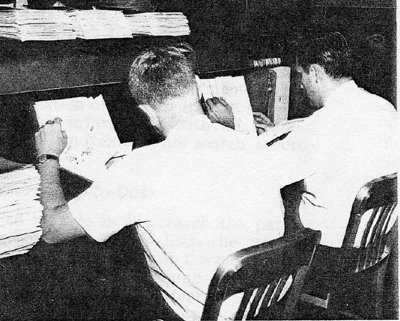
Photo: Patent searching circa 1960. Searchers (junior patent attorneys most likely) flip through stacks of paper patents in metal troughs located in the Patent Search Room.

The IP Mall, an online resource center for intellectual property information provided by the Pierce Law Center in Concord, NH, has digitized a fascinating collection of Patent Office Research and Development Reports from the 1950s and 1960s. The reports describe the Patent Office's early attempts at "mechanizing" or automating patent searching using coding schemes and early "punched card" computers.


Photo source: How to Obtain Information from United States Patents, Washington, DC: U.S. Patent Office, 1964.

Sunday, June 04, 2006

New USPC Classification Order: Class 439 - Electrical Connectors

The USPTO has published Classification Order 1,855, dated May 2, 2006. The order affects subclasses in Class 439, Electrical Connectors; it abolishes subclasses 620-622 and establishes 620.01-620.34.

Thursday, June 01, 2006

PTO Document Disclosure Program

The latest issue of ipFrontline has an interesting article called "The PTO's Document Disclosure Program: Boon or Boondoggle," by former patent examiner Thomas G. Field.

The USPTO is currently seeking public comment on a proposal to eliminate the program. See the Federal Register April 6, 2006, vol. 71, p. 17399. This is the third time since 1998 that the agency has proposed eliminating the 27-year old program.

USPTO's Disclosure Document Program brochure.